Every campsite in Grand Teton is booked ahead on Recreation.gov, up to six months out, and the park has no first-come campground, no overflow area and no pullout where you may sleep in a car. Below are the eight campgrounds, what fits at each and how the booking window works, then the first-come sites just outside the park, the free ones on Grassy Lake Road and the Bridger-Teton National Forest’s designated sites, for the nights the park is full.
How Grand Teton campsites are booked
Reservations only, on Recreation.gov. Every site in the park’s campgrounds is reserved in advance, and none is held back for anyone who turns up. The window is six months, rolling, so a night in mid-July opens to bookings in mid-January. Signal Mountain and Lizard Creek also allow up to 7 days to be reserved beyond the six months, so a stay booked at the edge of the window can run on past it, and they cap each customer at 2 sites a night. Jenny Lake, with 51 tent sites under the peaks, is the one to book the moment your dates open.
How long you can stay. 7 nights at Jenny Lake, 14 at every other campground, and no more than 30 nights a year across all of the park’s campgrounds.
Who fits on a site. Six people at most at Jenny Lake, Gros Ventre, Signal Mountain, Colter Bay and Lizard Creek, group sites aside, and two motorcycles count as one vehicle. Check-in is from noon and check-out by 11am at most of the campgrounds; the Colter Bay Tent Village’s cabins are ready after 2pm.
No plan B inside the park. Doubling up on a site is prohibited, and there are no overflow facilities. Camping along roadsides, at overlooks or in parking areas is not allowed, nor is sleeping in a vehicle in a pullout, parking area or picnic area, and a car may stay overnight at a trailhead only with a backcountry permit.
What a campsite does not cover. Park entry is paid separately, at the gate or ahead (entrance fees and passes, with the nonresident surcharge).
The eight campgrounds at a glance
| Campground | Sites (the park’s count) | What fits | 2026 season | From Jackson’s Town Square |
|---|---|---|---|---|
| Gros Ventre | 279 standard, 39 electric, 4 group | Tents; RVs to 45 feet; no water or sewer hookups | 27 April to 10 October | 11.4 miles, 19 min |
| Jenny Lake | 51, plus 10 for hikers and cyclists | Tents only; one vehicle up to 8 feet high and 14 feet long | 2 May to 27 September | 20.8 miles, 39 min |
| Signal Mountain | 56 standard, 25 electric | Tents; RVs to 30 feet | 8 May to 11 October | 30.3 miles, 52 min |
| Colter Bay Campground | 324 standard, 13 electric, 10 for hikers and cyclists, 10 group | Tents; RVs to 45 feet | 21 May to 27 September | 40.4 miles, 65 min |
| Colter Bay RV Park | 112 full hookup | RVs only, to 45 feet pull-through, 30 back-in | 4 May to 10 October | In Colter Bay Village |
| Colter Bay Tent Village | 66 tent cabins | Four bunks and a wood stove; bring bedding | 22 May to 7 September | In Colter Bay Village |
| Lizard Creek | 60 | Tents; RVs to 25 feet (30 in the park’s table) | 12 June to 13 September | 48.1 miles, 78 min |
| Headwaters at Flagg Ranch | 34 tent, 97 full hookup, 40 camper cabins | Tents; RVs to 45 feet; cabins | 7 June to 4 October | 55.8 miles, 1 hr 31 min |
The site counts are the park’s own table, last updated 27 December 2022; where Recreation.gov counts differently, the campground’s section below gives both. The seasons are 2026’s, from the park’s season table, last updated 10 September 2026 and marked “All dates are subject to change”. On 16 November 2026 the park had not posted 2027’s. The drives are our routing of 16 November 2026, which assumes every road is open; when the park’s roads open each spring is on our road openings page.
What a site costs
On 16 November 2026 Recreation.gov’s Grand Teton page listed each campground’s nightly price from:
| Campground | From, a night |
|---|---|
| Lizard Creek | $53 |
| Jenny Lake | $58 |
| Gros Ventre | $59 |
| Signal Mountain | $59 |
| Colter Bay Campground | $60 |
| Headwaters at Flagg Ranch | $63 |
| Colter Bay Tent Village | $101 |
| Colter Bay RV Park | $125 |
On top of the site, Recreation.gov charges a non-refundable reservation fee: $8 for a booking made online, as of 16 November 2026. Cancel before you arrive and $10 comes out of the refund; cancel the day before or the day of arrival and you also lose the first night, and a one-night stay canceled that late is not refunded at all. A group site canceled less than 14 days before arrival also forfeits its first night. A no-show pays $20 and loses the first night. Signal Mountain and Lizard Creek add a utility fee to their sites, reviewed each year and approved by the Park Service.
The campgrounds, one by one
Gros Ventre: the closest to Jackson
Gros Ventre (say “grow-vont”) is the park’s nearest campground to the town: an 11.4-mile drive from Town Square, about 19 minutes by our routing, which Recreation.gov puts at 20 to 25 minutes. Its 279 sites, 39 electric-only sites (10 of them accessible) and 4 group sites sit under cottonwoods beside the Gros Ventre River; no site is on the river, but all are within walking distance of it. Tent sites take two vehicles and up to two tents. RV sites are back-in, for one RV and its tow vehicle up to 45 feet in all, with drinking water at every comfort station and two dump stations across from the office at the entrance, but no hookup beyond electricity. There are no showers. Generators run only in loops A, B and C and along the East Corridor, and never in quiet hours, 10pm to 8am. Firewood and ice are sold at the office; there is no internet, and the nearest public Wi-Fi is in Jackson. Mormon Row and its barns are a short drive away. In 2026 it was the first campground to open, on 27 April.
Jenny Lake Campground: tents only, 7 nights
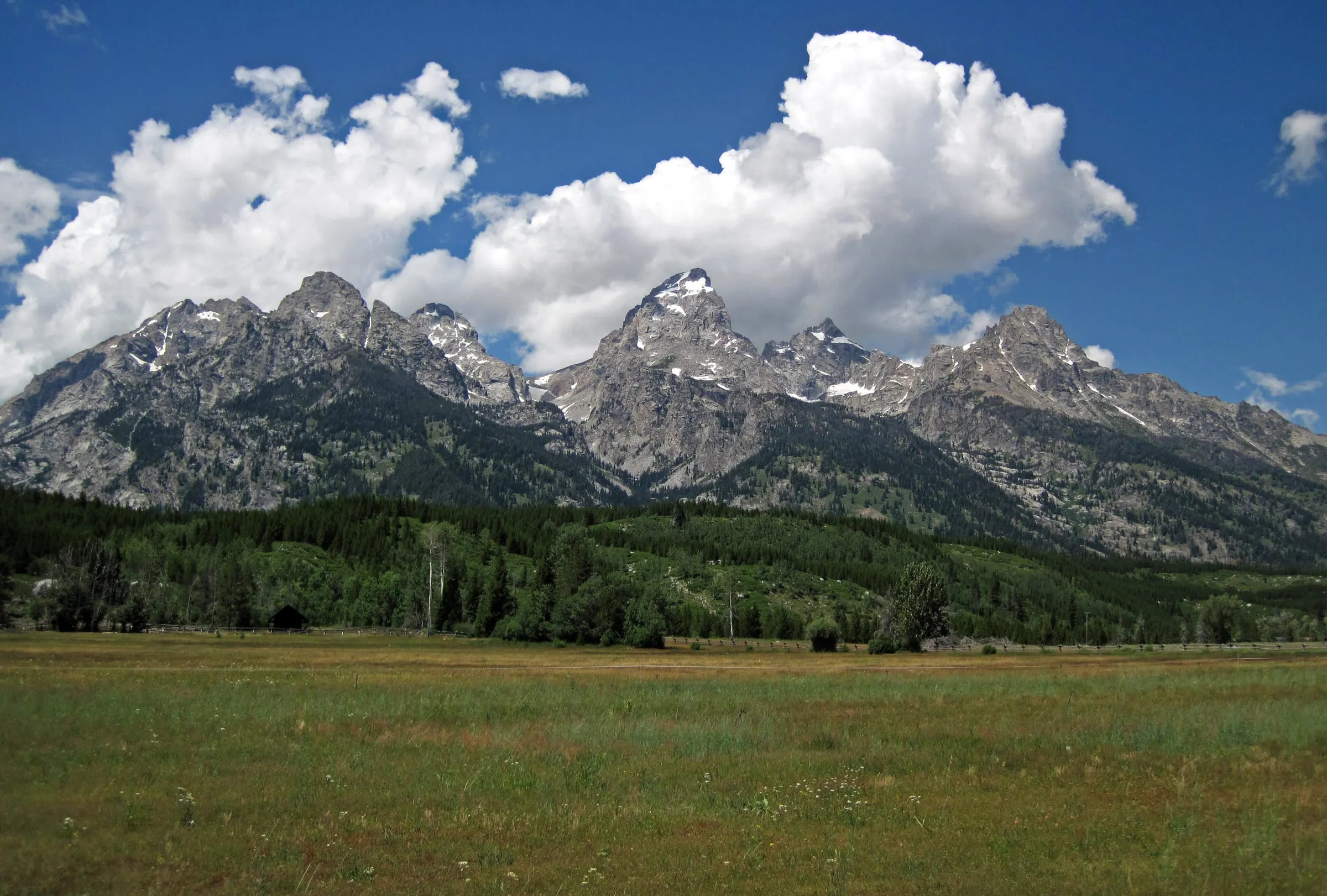
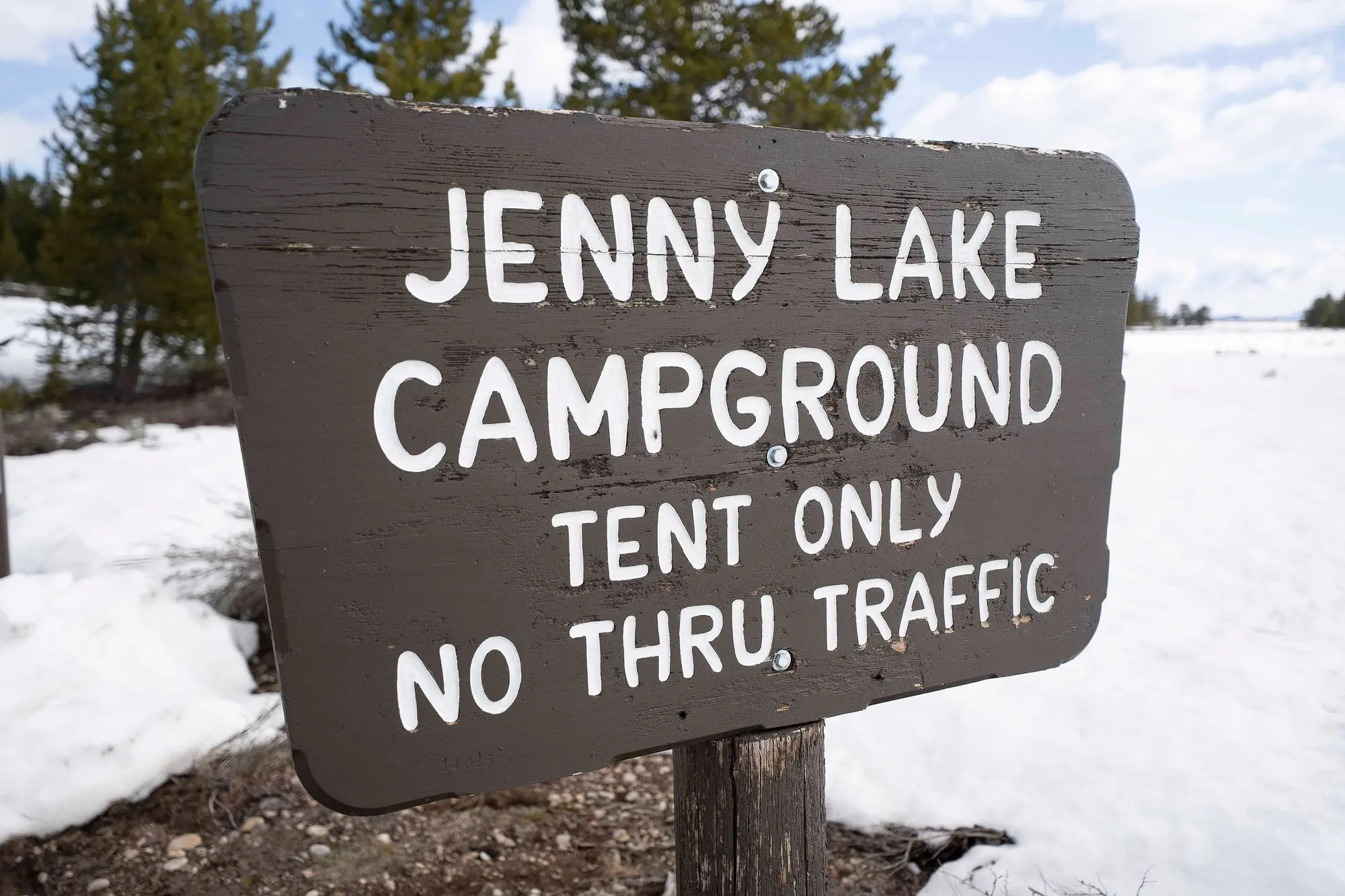
Jenny Lake Campground sits on a glacial moraine in lodgepole pine and fir, within walking distance of the lake’s east shore, with Teewinot Mountain, Mount St. John and the mouth of Cascade Canyon across the water. It also has the tightest rules of the eight. It is tents only: no trailers, campers, pop-ups or towables of any size, and no generators. Each of its 51 sites holds two tents, six people and one vehicle no larger than 8 feet high and 14 feet long, on a compact gravel pad; 3 of the sites are accessible, and 10 more are for hikers and cyclists. The campground road is narrow, and an oversized vehicle may not fit a site at all. Stays are limited to 7 nights.
Every site has water spigots and flush toilets nearby, there are two token-operated showers, and the Jenny Lake Store, a five-minute walk, sells firewood, ice and snacks; there is no Wi-Fi. Bears are frequent visitors here, so anything with a smell goes in the bear box or a closed, locked vehicle whenever you are not using it. Groups are sent to Colter Bay or Gros Ventre. The park’s multi-use pathway runs past the campground, all the way from South Jenny Lake to the town of Jackson, and the trails to Hidden Falls, Inspiration Point and Cascade Canyon start at the lake (Jenny Lake). Its 2026 season ran from 2 May to 27 September.
Signal Mountain: on Jackson Lake, the last to close
Signal Mountain Campground sits a little above the southeast shore of Jackson Lake, across the water from Mount Moran, beside Signal Mountain Lodge: a general store with groceries, gas and camping supplies, a restaurant and bar, token-operated showers, a laundromat, internet access and a cell tower on site. Its two sources count it differently. The park’s table, last updated in December 2022, lists 56 standard sites and 25 with electric hookups; Recreation.gov, where the sites are booked, describes 80 sites, 24 of them with 30- and 50-amp hookups, in a text that carries no date.
RVs and trailers are limited to 30 feet, and a vehicle with a trailer has to fit the parking pad or book a site with a double-wide driveway. Loop 1 holds the electric sites and allows generators, loop 2 allows them too, and loop 3 (sites 65 to 86) is generator-free; generators run from 8am to 8pm, and quiet hours are 10pm to 7am. Each site takes one vehicle, two tents and six people. In 2026 it was the last campground to close, on 11 October. Snow can linger on its sites in the first weeks after a heavy winter and winter weather can come early at the end of the season, so come ready for cold in May and October.
Colter Bay Campground, RV Park and Tent Village
Colter Bay Village, on Jackson Lake and a 40.4-mile drive from Jackson’s Town Square, holds three of the eight: a big campground, an RV park and a village of tent cabins, around a grocery store, restaurants, a laundromat with showers and a visitor center.
Colter Bay Campground is the largest in the park. The park’s table counts 324 standard sites, 13 electric, 10 for hikers and cyclists and 10 group sites. Recreation.gov’s description, which mentions the 2026 season and so is the newer of the two, counts 338 individual sites, 12 group sites, 10 hiker-biker sites and 13 electric-only sites, every one of them accessible. Tent sites take up to two vehicles and one tent, more only on a site marked for it; RV sites are back-in or pull-through, of varying length, with a 45-foot limit in the park’s table, and there is a free dump station and drinking-water fill. Generators run in loops H, J, K, M and O and the group sites, from 6am to 10pm. Showers and laundry cost extra. Its 2026 season ran from 21 May to 27 September.
Colter Bay RV Park has 112 full-hookup sites, with sewer, water and 20-, 30- and 50-amp power: pull-throughs for an RV and its tow vehicle up to 45 feet in all, and back-ins up to 30. No tents, no generators at any time and no wood fires, though gas and charcoal grills are allowed. It keeps the longest season of the three, 4 May to 10 October in 2026.
Colter Bay Tent Village is 66 tent cabins, and with Headwaters’ camper cabins it is the way to sleep in a campground with neither a tent nor an RV. Each has two log walls and two canvas walls under a canvas roof, two sets of pull-down bunks for four, padded, a wood-burning stove and lights, but no outlets, no private bathroom and no bedding, so bring sleeping bags and pillows (a few are rented out, first come, for a nightly fee). Outside each are a picnic table, a fire pit and a bear-proof locker. Cabins are ready after 2pm, oversized vehicles park a 5- to 10-minute walk away, and the 2026 season was the shortest at Colter Bay: 22 May to 7 September.
Lizard Creek: quiet, small, and the shortest season
Lizard Creek Campground has 60 sites on Fonda Point, on the north shore of Jackson Lake, 11 miles south of Yellowstone’s South Entrance and a 48.1-mile drive from Jackson. Nearly half are walk-in tent sites, set apart from where you park, and with no lodge or store beside it the campground is quieter than the rest. Its season is the shortest of the eight: 12 June to 13 September in 2026.
Its two sources disagree on length. Recreation.gov, where the sites are booked, allows trailers and RVs up to 25 feet, and a rig longer than its site’s driveway has to be unhitched, so it needs a site with a double driveway or one wide enough for both; the park’s table, from December 2022, says 30 feet. Plan on 25. Each site takes one vehicle, two tents and six people; generators are allowed only in the first loop (sites 48 to 63), from 8am to 8pm, and quiet hours are 10pm to 7am. Flush toilets, sinks and drinking water are in the campground, and ice and firewood are sold at its office. There is no boat ramp. Colter Bay, south along the lake, has public showers and a laundromat.
Headwaters at Flagg Ranch: between the two parks
Headwaters Campground at Flagg Ranch is in the John D. Rockefeller, Jr. Memorial Parkway, directly between Grand Teton and Yellowstone, two miles south of Yellowstone’s South Entrance and a 55.8-mile drive from Jackson. It has 34 tent sites, 97 full-hookup pull-through RV sites (sewer, water and 20-, 30- and 50-amp power) for an RV and its tow vehicle up to 45 feet, and 40 camper cabins: hard-walled, with padded bunks and a lantern, but no electricity, no private bathroom and no bedding. Showers are included, there is a coin laundry, and the main lodge beside the campground has a convenience store, a gift shop and Sheffields Restaurant. Cell and internet service are limited. Its 2026 season ran from 7 June to 4 October. On 16 November 2026 its Recreation.gov page still carried a notice of a multi-year construction project on the campground’s utilities, with noisy work kept to 9am to 6pm and the laundry on reduced availability.
Which campground for which trip
| If you are | Book | Why |
|---|---|---|
| In a tent, and want the peaks close | Jenny Lake | Tents only, a short walk from the lake, 7 nights at most |
| Over 30 feet, towing or driving | Gros Ventre, Colter Bay or Headwaters | 45-foot limits; Signal Mountain stops at 30, Lizard Creek at 25 |
| After full hookups | Colter Bay RV Park or Headwaters | The only two with sewer, water and power |
| Happy with power alone | Gros Ventre, Signal Mountain or Colter Bay | Electric-only sites, and Colter Bay’s are all accessible |
| Without a tent | Colter Bay Tent Village or Headwaters’ camper cabins | Bunks under a roof; bring your own bedding |
| Based on the town | Gros Ventre | 11.4 miles from Town Square, the nearest |
| Day-tripping into Yellowstone | Headwaters or Lizard Creek | 2 and 11 miles south of the South Entrance |
| Early or late in the season | Gros Ventre or Signal Mountain | In 2026 Gros Ventre opened first, on 27 April, and Signal Mountain closed last, on 11 October |
Camping near Grand Teton when the campgrounds are full
The park’s own list of fallbacks is the Rockefeller Parkway, the national forest, Yellowstone and the valley’s private campgrounds. In the order we would try them:
Same-day on Recreation.gov. Signal Mountain and Lizard Creek take reservations for the same day on Recreation.gov, though never at the campground itself, so a site that is free that morning can still be booked online.
Grassy Lake Road: 14 free sites from mid-June. Grassy Lake Road runs west from Flagg Ranch, beside Headwaters, toward Ashton, Idaho, and along it the Rockefeller Parkway has 14 designated campsites in eight areas: free, first come, first served, and open once the road does, in mid-June. They are primitive, with no water, but share toilets, bear boxes and trash collection. Camp only in a designated site, park only in the parking areas, store food properly, and no firearms may be discharged. The road itself is dirt and gravel, narrow and single-lane: four-wheel drive is strongly encouraged, and it is not recommended for trailers or large vehicles. It is unplowed in winter from Flagg Ranch west, and the park closes it by conditions.
The Bridger-Teton National Forest’s designated sites. Camping at undeveloped sites along forest roads has become extremely popular near the park and Jackson, and in those select areas the Forest Service allows it only at marked, designated sites, all first come, first served. It warns that they fill quickly, and asks you to bring water, garbage bags and a shovel. The ones nearest the park, with the Forest Service’s own directions from Jackson:
| Site | From Jackson | Worth knowing |
|---|---|---|
| Shadow Mountain | US 26/89 north 13.3 miles, right on Antelope Flats Road for 3.3 miles, left at the stop sign | The sites at the base fill quickly; toilet at the base, no water; the summit loop road is rough |
| Toppings Road | US 26/89 north 24.5 miles to the Cunningham Cabin turn, right on Forest Road 30310 | No trailers over 30 feet; tight switchbacks; Upper Teton View is very popular; toilet at the base, no water |
| Spread Creek | US 26/89 north 25.5 miles, right on Forest Road 30290 | Some sites take larger groups and RVs |
| Moran Vista | As Spread Creek, a quarter mile up Forest Road 30290, on Spread Creek Road | A good area for large RVs and for arriving late, next to the park; limited services |
| Pacific Creek | North to Moran, into the park, right on Pacific Creek Road to the forest | A decent gravel road along a wild and scenic river |
| Curtis Canyon | East Broadway, left on the Elk Refuge Road for 3.5 miles, right on Curtis Canyon Road and past the campground | No trailers over 30 feet; a narrow road with tight switchbacks; no marked sites until a mile past the fee campground |
The forest’s limit is 14 days in any 30-day period, after which you move at least 5 air miles and may not return to the same site for 30 days. From 1 May through Labor Day some heavily used areas near Jackson cut that to 5 days, and several popular corridors allow no camping at all. Food, garbage and anything scented go in a bear-resistant container or a vehicle, or are hung. Away from these areas, dispersed camping in the remote parts of the forest is free. The forest’s developed campgrounds in its Jackson and Blackrock districts include Atherton Creek and Turpin Meadow, where some sites are reserved on Recreation.gov, and Curtis Canyon, Pacific Creek and Hatchet, first come, first served.
A backcountry permit. It is the one other way to camp inside the park. Advance requests for the summer are taken on Recreation.gov from early January, and walk-in permits are issued no more than a day ahead at a permits office.
Further out, or a roof. For the drive north into Yellowstone, see Jackson to Yellowstone: the drive to Old Faithful. And if a tent was only ever the cheap way to sleep near the peaks, see Where to stay in Jackson Hole.
What every campground asks of you
Bear country, everywhere. Most sites have a metal bear box. Food, coolers, cooking gear, toiletries, trash and pet food go in it or in a closed, hard-sided vehicle whenever you are not using them, and Signal Mountain and Lizard Creek check.
Fires in the ring only. Most sites have a metal fire grate, and a fire stays in it. At Signal Mountain and Lizard Creek a fire may never be left unattended, a dry season’s fire restrictions can ban fires outright, and the Colter Bay RV Park allows no wood fires at all.
Quiet hours start at 10pm and end at 6am at Jenny Lake and at Colter Bay’s campground and tent village, 7am at Signal Mountain and Lizard Creek, and 8am at Gros Ventre and the Colter Bay RV Park.
Pets are welcome at Gros Ventre, Jenny Lake, Signal Mountain, the three at Colter Bay and Lizard Creek; at Signal Mountain and Lizard Creek they stay on a six-foot leash and are never left alone.