Grand Teton’s entrance fee is $35 a car for seven days, and the park takes it by card only. What trips people up is everything around that figure: the $100 a head that non-US residents pay on top, the second $35 that Yellowstone charges at its own gate, and the one pass that covers both parks.
What Grand Teton charges
| Pass | Price | What it covers | Who can buy it |
|---|---|---|---|
| Private vehicle | $35 | The car and everyone in it, for 7 days | Anyone |
| Motorcycle | $30 | Up to 2 private motorcycles with 4 riders between them, for 7 days | Anyone |
| Per person, on foot, bike or skis | $20 | One person aged 16 or over, for 7 days | Anyone |
| Grand Teton annual | $70 | The holder’s private vehicle, Grand Teton only, for a year through the month of purchase | US citizens and residents only |
| America the Beautiful, resident annual | $80 | One private vehicle fee, or four per-person fees, wherever a federal site charges an entrance or day-use fee, for a year | US citizens and residents only |
| America the Beautiful, nonresident annual | $250 | The same, and the $100 nonresident fee for everyone it covers | Anyone. The one annual pass open to non-US residents |
| America the Beautiful, senior | $20 a year, $80 for life | As the resident annual | US citizens and residents 62 and over |
Children under 16 need no pass of their own. The America the Beautiful pass is also free for current US military and their dependents, for Gold Star families and veterans (a lifetime pass), for US citizens and residents with a permanent disability, for US fourth graders and for volunteers with 250 hours at federal sites.
A pass is for the whole park, for as long as it runs: the same car pass covers Jenny Lake, the barns on Mormon Row and every other stop inside Grand Teton.
The two Park Service pages disagree on the motorcycle pass. Grand Teton’s fees page, updated 30 June 2026, has one $30 pass admitting up to two private motorcycles with four riders between them; the park’s FAQ page, last updated 17 July 2025, still prices entry per private motorcycle. The fees page is the newer of the two, and the Park Service’s own nonresident rules also count a pass as covering two motorcycles.
Every pass is shown with photo ID. The park asks for a driver’s license or other picture ID with any pass, and America the Beautiful passes are non-refundable, non-transferable and not replaced if lost or stolen. At least 80 percent of entrance fees stay in the park where they are paid, and Grand Teton says its fees pay for about $9 million of work a year on roads, trails, pathways and historic buildings.
Paying: by card, at the gate or ahead
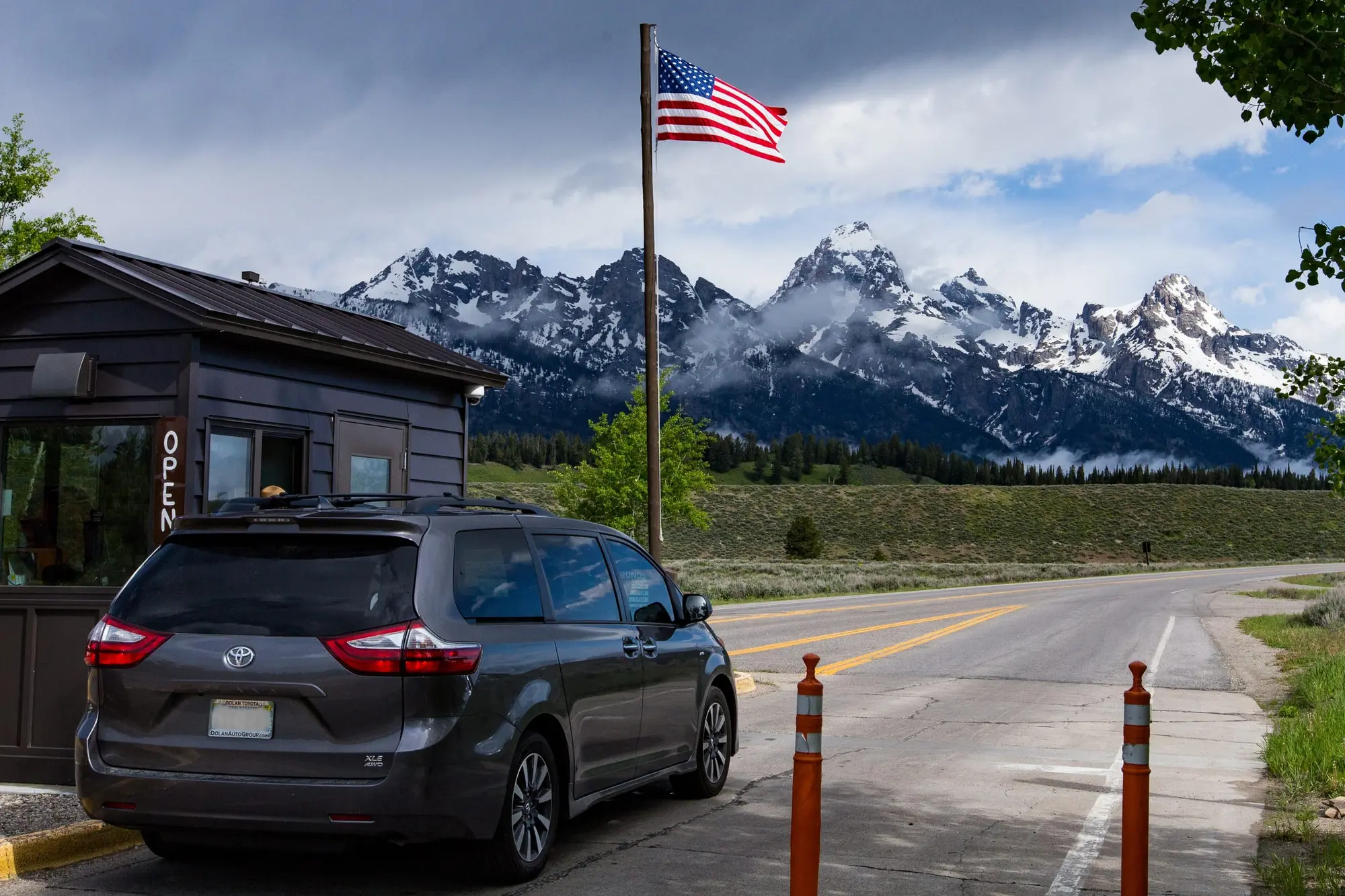
Grand Teton does not take cash. The park lists credit and debit cards only at the Moose Entrance Station. Yellowstone, the other half of many Jackson Hole trips, takes cash or cards at all five of its entrance stations, so the two parks give opposite answers to the same question.
Where passes are sold. At the park’s entrance stations, and at the permit desks in the Craig Thomas Discovery and Visitor Center at Moose and the Colter Bay Visitor Center, which sell the Grand Teton annual pass too. Both desks are seasonal: in 2026 the Craig Thomas desk was open from 10 April to 31 October and the Colter Bay Visitor Center from 8 May to 30 September.
Ahead of time. The park’s fees page sells the seven-day pass online through Recreation.gov. A digital America the Beautiful pass from Recreation.gov saves to a phone and works at once; a physical one ordered from the USGS Online Store can take up to three weeks to arrive by mail.
In Jackson. The National Elk Refuge’s visitor center, at 532 North Cache Street, sells America the Beautiful passes, and the refuge itself charges no entry fee at all. The refuge’s own page, with its winter sleigh ride, is the National Elk Refuge sleigh ride page.
No reservation. Grand Teton needs no vehicle reservation. You pay and drive in, and in summer that means lines at the entrance gates. What does need booking ahead in summer is on the summer 2027 page.
The $100 nonresident fee
The Park Service’s rule for Grand Teton:
Each non-US resident aged 16 and older visiting Grand Teton National Park must pay a $100 nonresident fee (in addition to the standard entrance fee), unless admitted with an Annual or America the Beautiful Pass. This includes nonresidents entering as part of a commercial tour group, commercial use authorization (CUA) group, or concessioner tour group.
It is charged at 11 national parks: Acadia, Bryce Canyon, Everglades, Glacier, Grand Canyon, Grand Teton, Rocky Mountain, Sequoia & Kings Canyon, Yellowstone, Yosemite and Zion. Both parks of a Jackson Hole trip are on the list, so a non-US resident pays it at each.
A pass in the car covers everyone in it. The Park Service’s rule is that every valid America the Beautiful pass and every park annual pass covers the entrance fee and the nonresident fee for the pass holder and all the passengers in a private vehicle (or on two motorcycles), and for the holder and three more adults where the fee is charged per person. Friends who live outside the United States, riding with a US resident who carries an $80 America the Beautiful, pay nothing more at either park, and with a $70 Grand Teton annual, nothing more at Grand Teton. The holder has to be in the car, with ID.
The annual pass a non-US resident can buy is the $250 one. The $70 Grand Teton annual and the $80 America the Beautiful are sold to US citizens and residents only, and buying the resident pass takes a US passport, a US driver’s license or state ID, or a green card. A visitor who buys the $80 digital pass without qualifying is asked to upgrade to the $250 one when showing it, photo ID in hand.
Whether the $250 pass pays for itself depends on how many adults are in the car and how many of the 11 parks the trip takes in. Children under 16 pay neither fee, so leave them out of the count:
| Non-US residents aged 16 and over, in one car | Grand Teton only, at the gate | Grand Teton and Yellowstone, at the gates | With the $250 pass |
|---|---|---|---|
| One | $135 | $270 | $250 |
| Two | $235 | $470 | $250 |
| Three | $335 | $670 | $250 |
So for one or two adults visiting only Grand Teton, paying at the gate is cheaper; from three adults the pass wins even there. The moment the trip also takes in Yellowstone, the $250 pass wins, by $20 for one adult and by $220 for a couple, and it keeps covering both fees at every other park on the list for a year.
On a tour, the fee still applies. The Park Service charges it to each non-US resident aged 16 and over on a commercial tour, and expects the operator to know before reaching the gate how many of its passengers are nonresidents and how many hold the $250 pass. On a tour, one $250 pass covers the nonresident fee for its holder and three more nonresidents aged 16 and over. Whether a tour’s price already includes the park fees is a term of that tour, worth reading before you book.
Does a Yellowstone pass work in Grand Teton?
No. Each park charges its own entrance fee, and a pass for one is not a pass for the other. Yellowstone’s own notice to visitors:
Traveling through Yellowstone’s South Entrance—including trips to Jackson, WY—takes you through Grand Teton National Park. Each park charges its own entrance fee!
Yellowstone’s prices are Grand Teton’s: $35 for a private vehicle for seven days, $30 for up to two motorcycles and $20 a person 16 and over on foot or by bike, with the same $100 nonresident fee, and Yellowstone adds $30 for up to two snowmobiles. Its own annual pass is also $70, also for US citizens and residents only, and good in Yellowstone alone.
The only pass that covers both is America the Beautiful. For a US carful seeing both parks on one trip, two seven-day passes at the gates cost $70 against the pass’s $80, so the gates win by $10 unless the pass will cover a third fee in the next 12 months: another national park, or any Forest Service, Fish and Wildlife Service or other federal site that charges an entrance or day-use fee. If anyone in the car is a US citizen or resident aged 62 or over, the $20 senior pass covers both parks for less than one gate fee.
The drive itself is on the Jackson to Yellowstone page, and when each park’s roads open to cars is on the road openings page.
Which pass to buy
- US resident, one trip, Grand Teton only: the $35 seven-day car pass, at the gate or online.
- US resident, Grand Teton and Yellowstone on one trip: two $35 passes, $70, or the $80 America the Beautiful if you will use it once more within the year.
- US resident, back in Grand Teton more than once a year: the $70 Grand Teton annual pays for itself on the second visit; the $80 America the Beautiful costs $10 more and covers Yellowstone too.
- Anyone in the car 62 or over and a US citizen or resident: the $20 senior annual or the $80 lifetime pass, which needs proof of age and residency.
- Non-US residents: work out the table above. One or two adults seeing only Grand Teton pay at the gate; three or more adults, or anyone also seeing Yellowstone, buy the $250 pass.
Free entrance days
The Park Service had not posted its 2027 list on 14 November 2026: its national passes page, last updated 9 October 2026, and Grand Teton’s fees page both still print 2026’s. In 2026 there were ten free days, all past now: 16 February, 25 May, 14 June, 3 to 5 July, 25 August, 17 September, 27 October and 11 November. We add 2027’s here once the Park Service posts them.
Since 2026 a free day is free only for US citizens and residents. Non-US residents pay the entrance fee and the $100 nonresident fee as on any other day, unless an annual or America the Beautiful pass covers the car. A free day waives the entrance fee only; other fees still apply.
What a pass does not cover
An entrance pass buys entry. The America the Beautiful covers entrance fees and standard day-use fees, and in Grand Teton campsites, backcountry permits and boat permits are each paid for separately. Campsites, how they book and what to do when they are full are on the Grand Teton camping page, and where the park fees sit in a whole trip’s budget is on what a Jackson Hole trip costs.