
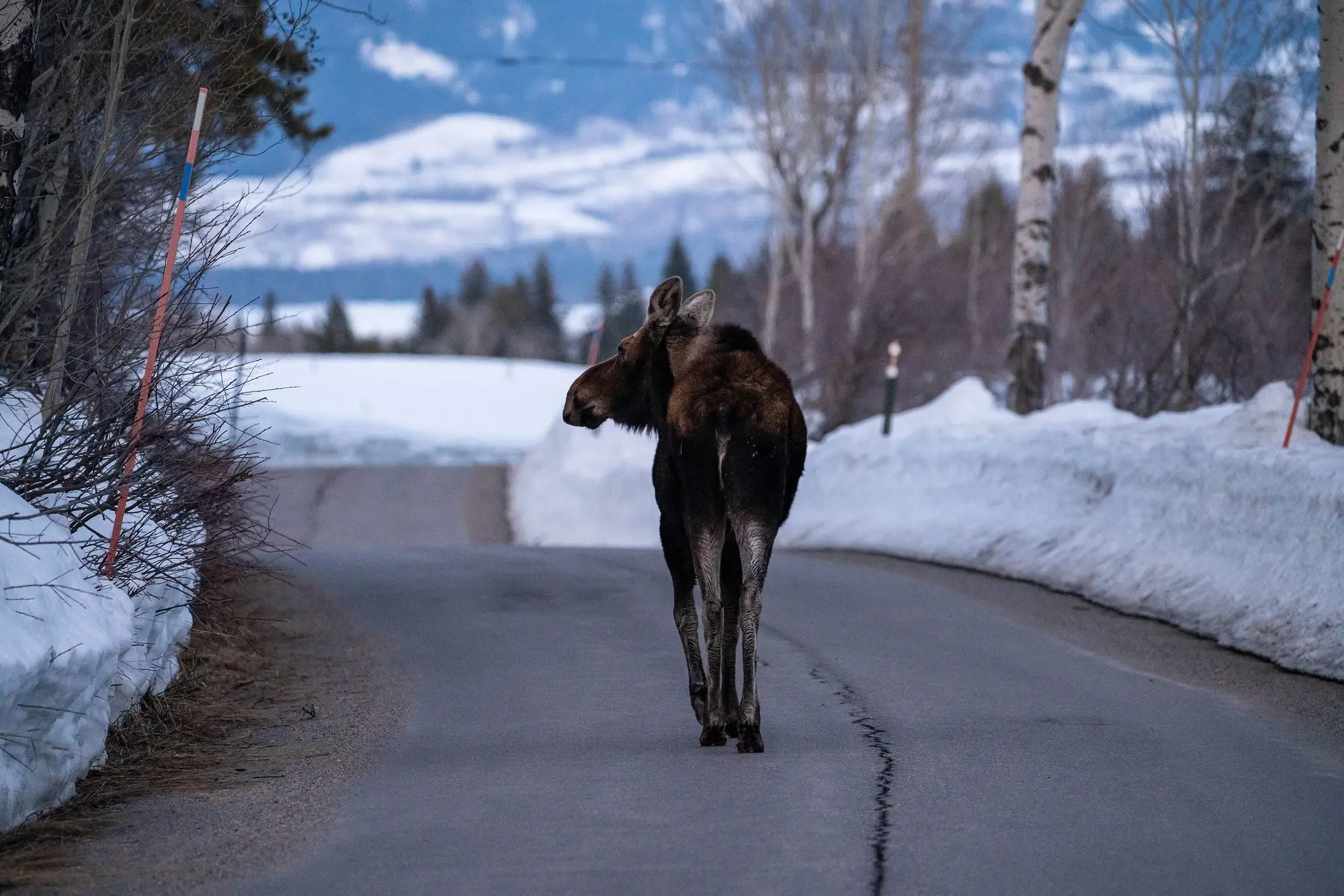

The Moose-Wilson Road is the slow back way between Teton Village and Moose: a narrow, winding road through forest and marsh below the southern end of the Teton Range, with the Laurance S. Rockefeller Preserve and its Phelps Lake, and the trailheads for Granite and Death canyons, along it. The park counts it as a common place to see wildlife, and moose, black bears and grizzly bears all live along it.
It is also a road under construction. Below are the drive and what may not drive it, when the park closes part of it (every winter, and in 2027 between the preserve and Moose for about seven weeks), the move of the Death Canyon Trailhead, the preserve and its hikes, and the wildlife, as each stood on 16 November 2026.
The drive, end to end
The Park Service describes the Moose-Wilson Road as a corridor road connecting the towns of Moose and Wilson, 15 miles long with 7 miles inside the park. From the town of Jackson, Highways 22 and 390 take you to Teton Village, 12.5 miles and about 23 minutes from the town square; beyond the village the road enters the park at the Granite Canyon Entrance Station.
Inside the park it runs north past the Granite Canyon Trailhead to the preserve, 2.2 miles on, then 3.7 miles more to its north end, which meets the Teton Park Road at Moose, 0.3 mile by road from the Craig Thomas Discovery and Visitor Center. With the short detour into the preserve’s parking lot, the Granite Canyon Trailhead to the visitor center is 7.0 miles, about 15 minutes without a stop. The park allows 20 to 60 minutes for the drive.
From the north end, the town square to the visitor center at Moose is 13.0 miles and about 21 minutes, and to the Rockefeller Preserve 17.2 miles, about 30 minutes, by Moose and 3.7 miles south on the road.
What may not drive it. The road is slow and winding, mostly paved with 1.5 miles unpaved. To promote traffic safety the park’s rules, signed in January 2026, bar any vehicle more than 8 feet wide or 23 feet long, and any vehicle towing a trailer or another vehicle, whatever its size. The one exception is a horse trailer going no farther than the Granite Canyon Trailhead from the south, or Death Canyon Road from Moose. Two of the park’s visitor pages give the length as 280 inches, 23.3 feet; the rule itself says 23 feet, so measure against that. Speed limits on the road are 20 and 25 mph.
Where the road runs through the preserve, no car may be left along it: the preserve’s conservation easement keeps parking to the lot. Dogs may ride along and get out in parking lots on a leash, but not on the preserve’s trails.
The road is inside Grand Teton National Park, and the park’s entrance pass covers it and the preserve, with no separate fee: $35 for a private vehicle for 7 days, $30 for up to two motorcycles, $20 a person 16 and over on foot or bicycle. Non-US residents 16 and over pay $100 more each unless admitted with an Annual or America the Beautiful pass. The park takes no cash. Every pass and what it covers is on our entrance fees and passes page.
When the road is closed
Every winter. The park closes the stretch from Death Canyon Road to the Granite Canyon Trailhead to cars from 1 November until about mid-May, depending on conditions, and leaves it unplowed, open to skiing, snowshoeing and hiking. Its roads page, last updated on 9 October 2026, gives those dates and that unplowed stretch; its winter alert for 1 November 2026 to 31 March 2027 and its rules name the same stretch as the one closed to vehicles, open to walking and biking while it is free of snow and to skiing, snowshoeing and walking once snow covers it. Leashed dogs are allowed on the unplowed part, on a leash six feet long at most. The park’s Moose-Wilson Road page, last updated in May 2026, gives the winter closure as the whole stretch between Moose and the Granite Canyon Entrance Station; the roads page, the alert and the rules are the newer.
In spring. The park’s spring page, last updated in April 2026, opens the road to vehicles once it is free of snow and warns of brief delays.
What is open on a given day, construction closures included, the park posts on its Alerts and Current Conditions page. Our road openings guide follows every park road through 2027.
The 2027 construction, and the Death Canyon Trailhead
The park is rebuilding the road’s north end. Its Moose-Wilson Road Phase II project, with a timeframe of May 2026 to June 2027, re-aligns the road north of Sawmill Ponds to meet a new roundabout on the Teton Park Road, just north of the Moose Entrance Station. Once it is built, traffic heading north off the Moose-Wilson Road will join the Teton Park Road there without passing through another entrance station. Parts of the road close while it is built, so that equipment and materials can reach Death Canyon Road.
A second project is planned beside it. In August 2026 the park amended its plan for the road to add a separate multiuse pathway along the corridor and to move about 1.5 miles of the road, from the Sawmill Ponds Overlook toward the Rockefeller Preserve, out of the wetlands. On 3 November 2026 its planning page said the first half mile or so of pathway, from the new roundabout at Moose to the foot of the Sawmill Ponds hill, could be built from summer 2027 alongside the work there, with possible traffic delays and access changes, and that the amendment did not change the 2027 schedule below. No other section of the pathway had a construction date, because the money to build it was not yet available.
The park paused its construction for winter from 15 November 2026 to 1 May 2027. Its construction page, updated on 2 November 2026, gives this anticipated schedule for summer 2027:
| Where | Anticipated 2027 schedule |
|---|---|
| Moose-Wilson Road between the Rockefeller Preserve and Moose | Closed, 1 May to 19 June |
| Death Canyon Road and Trailhead | Closed to all use, 1 May to 19 June |
| Teton Park Road at the new roundabout, Moose | Delays of 20 minutes, 1 May to 15 November, not counting the wait at the entrance station |
While the north end is closed, the only way to the preserve by car is from the south, by Teton Village and the Granite Canyon Entrance Station, and that stretch opens for the season only when the winter closure ends, about mid-May. The park expects parking at the preserve to be limited, with long waits, while Death Canyon is shut. In 2026 the Preserve Center opened on 1 June.
The Death Canyon Trailhead is moving about a mile from where it stood. The new trailhead will have restrooms, a hiker staging area and about 90 paved parking spaces. Death Canyon Road will be paved, shortened by a mile and end there, and the mile of road it no longer needs becomes an extension of the Valley Trail to the Phelps Lake Overlook and Death Canyon, so hikes into Death Canyon and beyond will be longer. On 2 November 2026 the park had paused the work until 1 May 2027, with the former trailhead transformed, new facilities installed, concrete poured and the site prepared for paving. While the road and trailhead are closed, Phelps Lake, Death Canyon and the trails beyond are reached from other trailheads, among them Granite Canyon and Jackson Hole Mountain Resort.
The Laurance S. Rockefeller Preserve
This was the JY Ranch. Lewis Joy and Struthers Burt opened the valley’s first dude ranch on the east shore of Phelps Lake in 1908, and John D. Rockefeller, Jr. bought the land in 1932, meaning to give it to the park, then kept it as a family retreat. His son Laurance donated about 2,000 acres in 1990 and in 2001 announced he would give the remaining 1,106 acres of the ranch to the park. Between July 2004 and May 2007 thirty buildings, roads, utilities and other structures were taken out to restore the land; the park took it over in November 2007, and the Preserve Center opened on 22 June 2008. The park describes the preserve as a place designed to reduce congestion and leave room for solitude and reflection.
The Preserve Center is certified LEED Platinum, the top grade of green building. Its exhibits work through sight, sound and touch, linked by a poem by Terry Tempest Williams, with recordings of Laurance Rockefeller speaking about conservation, nature videos, large photographs and a soundscape room of recordings made in the preserve. A resource room has books, maps, chairs and a fireplace. Rangers give trail and weather information and lead daily programs, among them a hike to Phelps Lake, and children aged 6 to 12 can borrow a Nature Explorer’s Backpack, one per family. The center issues no permits. The park opens it daily from early June to late September; in 2026 that was 1 June to 20 September.
Parking. The preserve’s lot holds 50 cars. The park’s preserve page, updated in July 2026, says it is often full from before 8 a.m. to 5 p.m.; its older trailhead page, from April 2025, put the full hours at 9 a.m. to 4 p.m. in peak summer. Once the lot fills, cars wait in line for a space. Arrive early, or plan on a wait in mid-summer, and share a car if you can: the park asks visitors to carpool. Overnight backcountry campers may not leave a car in this lot. There are restrooms in the lot, at the center and just before the lakeshore, the last with no drinking water, and the park recommends groups of ten at most.
The hikes. The preserve’s trails start at a kiosk outside the center. Two loops start there:
| Loop | Park trail page, June 2026 | Park trailhead page, April 2025 |
|---|---|---|
| Lake Creek-Woodland | 3 miles, 770 feet of climbing, easy, 1–3 hours | 3.0 miles, 300 feet, easy, 1.5 hours |
| Phelps Lake | 6.4 miles, 1,060 feet of climbing, moderate, 3–5 hours | 6.3 miles, 600 feet, moderate, 4 hours or more |
The two pages disagree on the climbing; the June 2026 figures are the newer. The Lake Creek-Woodland loop follows Lake Creek through the forest to the shore of Phelps Lake, with views into Death Canyon, and returns on the Woodland Trail; the trail is wide and mostly level, with some rocks and roots. The Phelps Lake loop goes all the way around the lake, over several bridges and a wetland boardwalk, with views into Death Canyon and the southern end of the Teton Range, and the Aspen Ridge or Boulder Ridge trails can be added on the way. Phelps Lake is about 160 feet deep, filling a basin that glaciers carved as they flowed out of the canyons and dammed with the moraines they left. The longer hikes into Granite Canyon, toward Marion Lake, and into Death Canyon start from the Granite Canyon and Death Canyon trailheads, both reached from the road.
Moose, bears and the road’s other wildlife
The park counts black bears, grizzly bears, moose and deer among the large animals living along the Moose-Wilson Road and in the preserve, and says bears are often seen on the trails and around the buildings. Black bears come blond, cinnamon, brown or black and grizzlies brown to black, so color does not tell you which one you are looking at.
Near the road’s Moose end, Sawmill Ponds is the marsh to watch for moose. Al Young moved his sawmill here in 1923 and ran it beside the spring-fed beaver pond until the park was established in 1929; today the wetlands are home to moose, beavers and waterfowl, and the overlook is wheelchair accessible. Dawn and dusk are the best times to look, though you may catch a glimpse in the heat of the day too.
Along the whole road, use the pullouts to watch or take photographs, obey the posted signs, and watch for animals on the road. Keep at least 100 yards from bears and wolves and 25 yards from moose and every other animal, whether you are on foot or in a car.
Where else in the park to look for moose, bears and the rest is on our wildlife guide, and the guided wildlife trips from Jackson are compared on our wildlife safaris page.


