
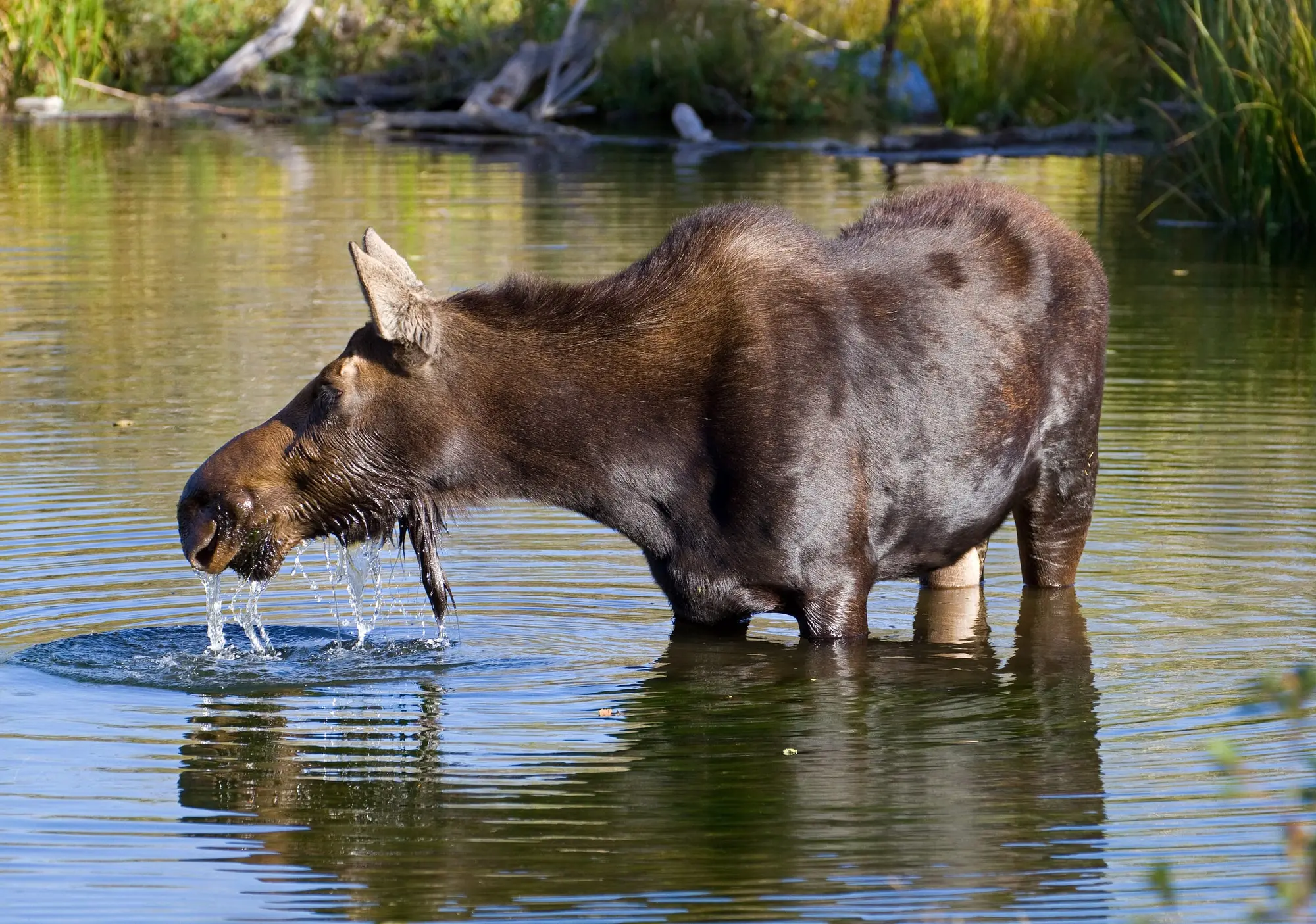

Grand Teton’s big animals are easiest to find from the road. Moose feed in the willows along the rivers and lakes, bison and pronghorn graze the sagebrush flats, and elk step out of the trees at dawn and dusk, and all of them are watched from roadside pullouts; bears, wolves and mountain lions are harder to find. Sixty-one kinds of mammal live in the park.
Below are the places to look, one by one, then each animal, what each season moves around, and the rules on distance and closures that keep you and the animals out of trouble, as they stood on 16 November 2026.
The hours that matter
Dawn and dusk are the best times to watch from your car along most park roads. Through the heat of the day many large animals rest in the shade, and they come out again as it cools. Bison and pronghorn are the exception: both graze through the day.
Bring binoculars, a spotting scope or a long lens for close views. The distances the park requires (below) mean you watch from well back.
Where to look, place by place
| Place | Where it is | What to look for |
|---|---|---|
| Oxbow Bend | 1 mile east of Jackson Lake Junction | Moose, river otters, beavers, pelicans, bald eagles |
| Willow Flats | The overlook is 6 miles south of Colter Bay | Moose, elk, birds; grizzlies and wolves in early summer |
| Colter Bay | On Jackson Lake | Elk, coyotes and grizzlies in the meadows; ospreys and herons |
| Snake River | Jackson Lake Dam south to Moose | Elk and bison in the meadows, moose in the willows, eagles |
| Timbered Island | A forested ridge southeast of Jenny Lake | Pronghorn by day, elk at dawn and dusk |
| Mormon Row and Antelope Flats | East of the highway, 1 mile north of Moose Junction | Bison and pronghorn, spring to fall |
| Blacktail Pond | Half a mile north of Moose on the highway | Elk in the cool hours, moose, ducks |
| Moose-Wilson Road | Between Moose and Wilson | Black and grizzly bears, moose, deer |
| Cascade Canyon | West of Jenny Lake | Moose and mule deer, pikas, marmots, black bears |
| National Elk Refuge | At Jackson, in winter | Elk, bighorn sheep, trumpeter swans, bald eagles |
Oxbow Bend is a slow cut-off loop of the Snake River a mile east of Jackson Lake Junction, 33 miles and about 50 minutes by road from the Town Square in Jackson. Its fish feed river otters, ospreys, bald eagles, American white pelicans and common mergansers; beavers and muskrats swim it, and moose browse the willows at the water’s edge. Elk sometimes graze the open aspen groves to the east, sandhill cranes are seen there, and now and then a grizzly hunts along it. On calm days Mount Moran is reflected in the water; for sunrise there, see our Schwabacher Landing and Oxbow Bend page.
Willow Flats spreads north of Jackson Lake Dam, and the Willow Flats Overlook looks across it, 6 miles south of Colter Bay. Moose browse the willow shrubs, and elk graze the grass among them at dawn and dusk. In early summer wolves and grizzly bears hunt the elk calves here, and Willow Flats itself is closed to public entry from 15 May to 15 July, or when posted: follow the signs.
Colter Bay, on Jackson Lake, sits in good habitat. Its meadows draw coyotes, elk and grizzly bears as well as songbirds and ground squirrels, and ospreys, mergansers and herons work the lakeshore. Bears frequent the area: black and grizzly bears, moose and elk are often seen on its trails and among the buildings. At Two Ocean and Emma Matilda lakes, elk graze at dawn and dusk and shelter in the forest by day, moose browse the lakeshore willows, and mule deer, coyotes and both kinds of bear use the country around them.
The Snake River, from Jackson Lake Dam south to Moose, has elk and bison grazing the grassy meadows along its banks, and bison on the sagebrush benches above it too. Bald eagles, ospreys and great blue herons build big stick nests within sight of the water, and beavers and moose feed on the willows that line it. Schwabacher Landing, at the end of a road that leaves the highway about 4 miles north of Moose Junction, is a popular place to watch the sunrise and spot wildlife.
Timbered Island is a forested ridge southeast of Jenny Lake. Small bands of pronghorn, the fastest land animal in North America, graze the sagebrush around it all day, and elk leave its shade at dawn and dusk to feed. The same pattern runs along the Teton Park Road: pronghorn in small groups on the sagebrush, elk on the forest edges early and late, and black bears crossing between the trees and the flats. That road is closed to cars from 1 November to 30 April between Taggart Lake Trailhead and Signal Mountain Lodge; for its opening, see our road openings guide.
Mormon Row and Antelope Flats, east of the highway a mile north of Moose Junction, are where to find bison and pronghorn from spring to fall. Both graze through the day, so the loop from Antelope Flats round to Kelly is the drive to make when the dawn and dusk animals have gone to cover. Coyotes, northern harriers and American kestrels hunt mice, Uinta ground squirrels and grasshoppers on the flats, and sage grouse, sage thrashers and sparrows live there. Mormon Row is 15.5 miles, about 25 minutes, from the Town Square, and Antelope Flats Road closes for winter by conditions. Our Mormon Row page covers the barns, the parking and the park’s work there into 2027.
Blacktail Pond, half a mile north of Moose on US 26/89/191 (the park’s mammal brochure calls the turnout Blacktail Ponds), is old beaver ponds that have filled with sediment and turned to grassy meadow. Elk graze it in the cooler parts of the day, ducks feed in the side channels of the Snake, and moose browse the willows along the river.
The Moose-Wilson Road winds through forest and marsh between Moose and Wilson. Black bears, grizzly bears, moose and deer live along it, and it is a common place to watch wildlife. It has closures from time to time: for those, see our Moose-Wilson Road page.
Cascade Canyon, west of Jenny Lake, has mule deer and moose browsing at its mouth, pikas and yellow-bellied marmots in its boulder fields, and black bears in the canyon. Golden-mantled ground squirrels beg at Inspiration Point. Feeding them is illegal, and a bite can pass on diseases such as rabies. For the way there, see our Jenny Lake page.
The National Elk Refuge, at Jackson, is where the elk go in winter. They are typically in view there from mid-December through early April, with bighorn sheep, trumpeter swans and bald eagles. Most winter visitors see them from a horse-drawn sleigh or by driving the Refuge Road; for the sleigh rides, see our National Elk Refuge page.
Animal by animal
Moose
Moose eat willows, so look where willows grow by water: the edges of Oxbow Bend, Willow Flats north of Jackson Lake Dam, the Snake River from the dam south to Moose, Blacktail Pond, the shores of Two Ocean and Emma Matilda lakes, the mouth of Cascade Canyon and the Moose-Wilson Road. Go early or late in the day. In fall the bulls go looking for cows and may spar for dominance. Never get between a cow and her calf: mothers with young are especially defensive.
Bears
Black and grizzly bears both live in every part of the park. Grizzlies began returning to Grand Teton in the 1990s and have occupied all of it since 2009; more than 1,000 now live in the Greater Yellowstone Ecosystem, which takes in both parks, and park biologists have found the local population at the most the land can carry. Black bears favor forests and canyons, grizzlies open country, and both use the subalpine and the river bottoms.
Color will not tell them apart, since both run from blond to black. A grizzly has a hump at the shoulder, a dished face, short rounded ears and front claws 2 to 4 inches long. A black bear has no hump, a straight face from nose to ears, tall pointed ears and claws of 1 to 2 inches.
Grizzlies hunt elk calves on Willow Flats in early summer, use the meadows around Colter Bay and now and then hunt the edges of Oxbow Bend. Both kinds use the country around Two Ocean and Emma Matilda lakes and along the Moose-Wilson Road, and around Moose bears are often seen on trails and near the buildings. Black bears frequent Cascade Canyon.
Much of the bear watching here happens from the road. In 2024 the park’s Wildlife Brigade, the rangers and volunteers who manage the crowds at a roadside bear, handled 254 black bear jams and 224 grizzly bear jams. Where a bear lingers at a campground, a lodge or another developed area, the staff move it on: those are not places to watch bears.
Bison
Bison summer on the sagebrush plains of the park’s east side. From spring to fall look for them along Mormon Row and Antelope Flats Road, where a herd is often in the area, and in the meadows and on the benches along the Snake River. They graze through the day. In fall they move south to lower ground, where there is less snow over the grass, and the National Elk Refuge holds winter range for them as well as for elk and wolves.
Elk
Of the park’s hoofed animals, only elk are rated abundant on its mammal list. Look for them at dawn and dusk at Timbered Island and along the Teton Park Road, in the meadows at Blacktail Pond and Willow Flats, around Two Ocean and Emma Matilda lakes, along the Snake River and in the meadows at Colter Bay.
In fall the bulls gather harems of cows and bugle to challenge each other, an eerie sound in the early evening, and evenly matched bulls spar. Then the herd moves south: the elk that summer in the park belong to the Jackson elk herd, the largest elk herd in North America, and winter on the National Elk Refuge.
When needed, the park holds an elk reduction program from early November to early December, in which hunters with a park permit and a Wyoming elk license take elk in an area mostly east of US 89. If you are out there then, wear bright colors.
Pronghorn
Pronghorn graze the sagebrush around Timbered Island through the day, along Mormon Row and Antelope Flats from spring to fall, and in small groups by the Teton Park Road. In fall the Teton herd gathers and walks 150 miles south to winter near Pinedale, Wyoming, a route its members have followed for nearly 7,000 years. It is the second longest land migration in the Western Hemisphere.
Wolves and the rest
Wolves are uncommon in the park and seen only now and then; in early summer they hunt elk calves on Willow Flats. Mountain lions are rarer still. Among the smaller animals, beavers, muskrats and river otters swim Oxbow Bend, pikas and yellow-bellied marmots live in the rocks of Cascade Canyon, and coyotes and Uinta ground squirrels are common on the flats.
Season by season
Spring. Bears leave their dens and move down to low ground where the snow has melted and the first food comes up. A bison herd is often near Mormon Row. In late spring the elk leave the refuge, and most follow the melting snow up into the park and the Bridger-Teton National Forest. The road toward Kelly and the Gros Ventre River is a good spring drive for animals.
Summer. Willow Flats is closed to entry from 15 May to 15 July, or when posted, a window that takes in the early summer, when wolves and grizzlies hunt elk calves there. Midday heat sends many large animals into the shade, so plan the drives for early and late; bison and pronghorn stay out on the flats all day.
Fall. The rut: elk bugle in the evenings, and bull moose and bull elk spar. Bears eat berries and anything else they find, putting on fat for winter. Pronghorn start their long walk south, bison head for lower ground, and the elk drift toward the refuge. The elk reduction program, when held, runs from early November to early December, and the middle of the Teton Park Road closes to cars on 1 November.
Winter. US 89/191 and US 26/287 are plowed from Jackson to Flagg Ranch, and that drive has mountain views and wildlife to watch. Elk are typically on the National Elk Refuge from mid-December through early April, with bighorn sheep, trumpeter swans and bald eagles. Bears are out and about even in most winter months. Winter wears animals down, so give them extra room: harassing wildlife is prohibited, and the closures below keep people away from the places they winter.
How close you may get
Stay at least 100 yards from bears and wolves and 25 yards from every other animal, whether you are on foot or in your car. Those are minimums. Give mating grizzlies and mothers with cubs more, and if an animal runs, stops feeding or seems agitated, you are too close; if it comes toward you, move away. A quick check for bears: hold out your thumb at arm’s length, and if it does not cover the whole bear, you are inside 100 yards.
At a wildlife jam:
- pull off with all four tires right of the white line, and never park in the road;
- do not park in front of an animal that is crossing, and do not approach it;
- watch for traffic and for people on foot, and do not stand in the road;
- do what the park staff tell you. They may keep you in your car, wave you through, or close the jam and send everyone on.
It is illegal to feed any wildlife, ground squirrels and birds included.
Drive slowly, above all at dawn and dusk. Each year 75 to 100 large animals are hit by vehicles on park roads. Speed limits run from 25 to 55 mph, and US 26/89/191 has a nighttime limit of 45 mph.
On foot, hike in a group of three or more, make noise, and carry bear spray where you can reach it at once, not in your pack. Use it only on a charging or aggressive bear, aimed low, in a 1- to 2-second burst once the bear is within about 30 feet. Bear spray is sold in shops, grocery stores and service stations in the park and in the towns around it. Never store it in a car: it can overheat and explode.
Closures that move animals and people
The park closes these places every year:
- areas around the Snake River, the Buffalo Fork River and Kelly Hill: closed to all public entry from 15 December through 31 March;
- Willow Flats: closed to public entry from 15 May through 15 July, or when posted;
- the summits of Mount Hunt, Prospectors Mountain and Static Peak: closed from 1 December through 30 April, and the Bighorn Sheep Winter Zones, which the park asks you to keep out of over the same months;
- the ground around nesting bald eagles and other birds along rivers and lakes, as the park maps it.
On top of those, the park closes a trail for a while when a carcass lies near it, closes areas in high-use bear country and sets no-stopping zones. It lists its temporary closures on its Temporary and Wildlife Closures page, and the signs on the ground always rule.
With a guide
If you would rather leave the dawn driving and the spotting to someone else, see our wildlife safaris page for the guided wildlife trips from Jackson.


