
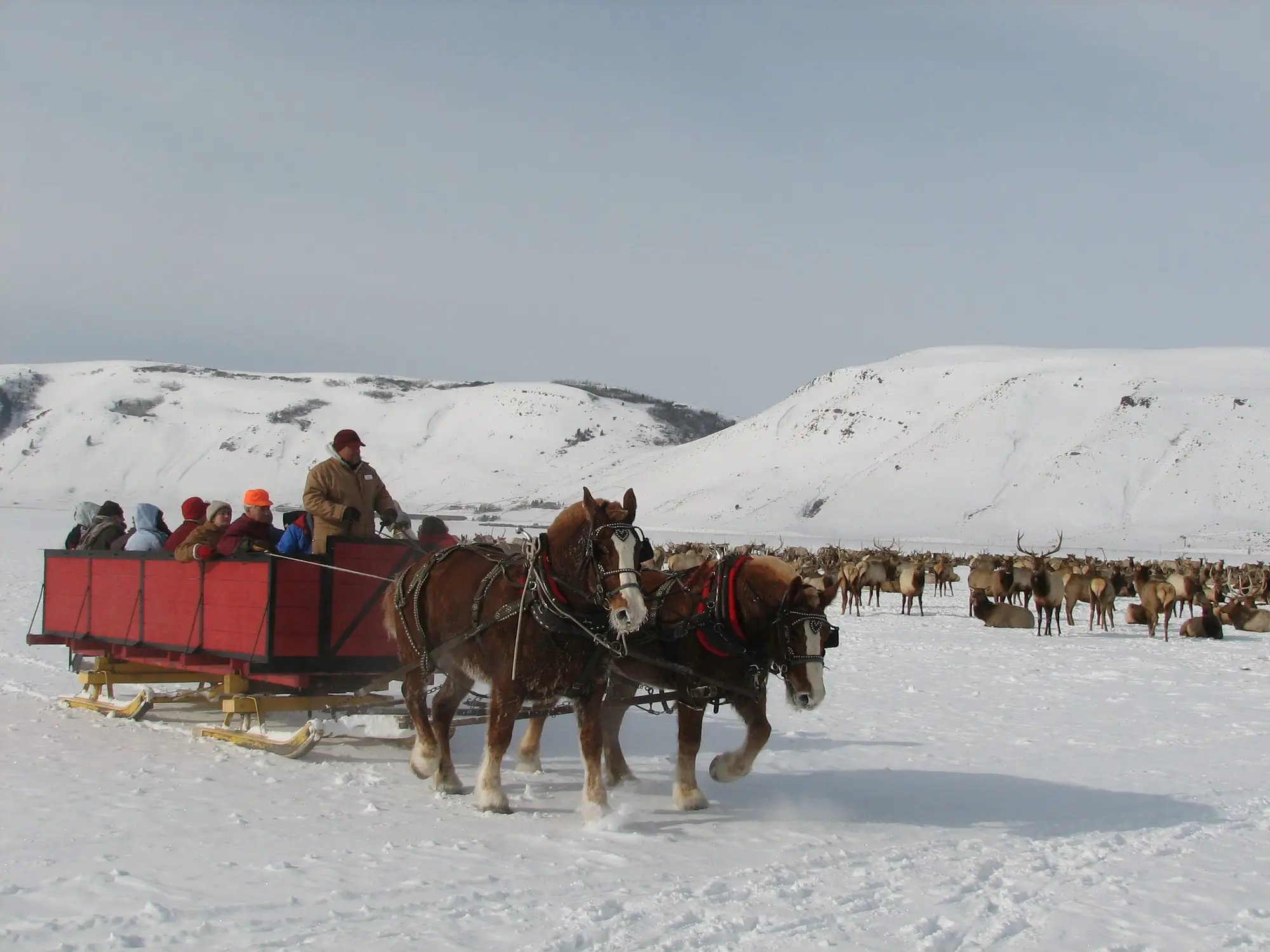

The National Elk Refuge begins where the town of Jackson ends: more than 24,700 acres of grassland, forest and wetland where thousands of elk spend the winter. Each winter, horse-drawn sleighs carry visitors out among them, a tradition about a century old. Double H Bar runs the rides as the refuge’s concessionaire, from the visitor center on North Cache Street.
Below are the 2026–27 season’s dates, hours and fares, how the ticket, the shuttle and the sleigh work, what you see and when, the visitor center, and the free ways to see the refuge, as each stood on 16 November 2026.
The 2026–27 season: dates, hours and fares
For 2026–27 the concessionaire set the season at 19 December 2026 to 3 April 2027, conditions permitting, and closed on Christmas Day. Rides run from 10 a.m. to 4 p.m. every day of the season, and the ticket trailer opens at 9 a.m.
| 2026–27 fares | Price |
|---|---|
| Adults | $43 |
| Children 5 to 12 | $28 |
| Children 4 and under | Free |
The driver’s tip is not included. Reservations are taken but not required: tickets are sold on the day, and only in the holiday weeks does the concessionaire highly recommend reserving a time.
The refuge itself charges no fee to visit. It is run by the U.S. Fish and Wildlife Service, not the National Park Service, so a national park pass does not cover the sleigh ride. Grand Teton’s own passes, and what the America the Beautiful pass covers, are on our entrance fees and passes page.
How it works: the ticket trailer, the shuttle and the sleigh
Tickets are sold from a white trailer in the parking lot of the refuge’s visitor center, 532 North Cache Street in Jackson, from 9 a.m. to 4 p.m. in the sleigh season. With a reservation, check in there 30 minutes before your time. A shuttle leaves the lot every 20 to 30 minutes and takes riders out to where the sleighs load.
The ride itself lasts about 45 minutes to an hour, and the whole outing, from check-in to drop-off, about an hour and a half. A sleigh holds roughly 16 adults, and snow or pulling conditions can lower that. The driver is also your guide, and takes questions on everything from antlers and the rut to how the refuge is managed and why it exists.
The sleigh is open to the weather, and the concessionaire neither provides nor sells blankets, so bring your own. Pets stay behind, and so do food and drink, even a thermos: other animals’ scents and foreign food disturb the elk, and a barking dog would send them running. The rides close for weather now and then; on a stormy day, check that they are running before you set out.
This is a wildlife ride, not a dinner sleigh. For a ride inside a guided day, several private winter tours from Jackson pair the refuge’s sleigh ride with a guided wildlife drive in Grand Teton, some with lunch. For two of them, see our guide to Jackson Hole in winter without skiing.
What you see from the sleigh
Elk, by the thousand. The refuge was established in 1912 to keep elk from starving, and thousands still spend the winter on it. Small numbers arrive through November, more come in December as deepening snow pushes them down from their summer ranges, and the herd levels off through January and February. In spring most follow the receding snow back up into Grand Teton National Park and the Bridger-Teton National Forest, usually starting in March or April; there are no elk on the refuge in summer. They are typically in view from mid-December to early April, and the severity and length of the winter shift the timing.
Antlers. The bulls start dropping their antlers at the end of February and go on through March, with a few younger bulls keeping theirs into April. For bulls still in antler, ride before late February.
Time of day. In the morning the elk are often up and grazing; in the early afternoon many lie down, and in the evening they graze again. The warmest part of the day runs from about 11 a.m. to 2 p.m. They are wild animals, and weather changes what they do from day to day and even hour to hour.
The rest. Bald eagles, trumpeter swans and coyotes are common winter sights on the refuge, and bison, wolves, foxes, badgers, deer, ducks and geese turn up on some rides. The Teton Range is on the skyline.
The refuge and its elk
Whether the elk are fed in a given winter is decided by the refuge and the State of Wyoming. When they are, refuge staff usually feed in the morning, the elk crowd together to eat, and once the feed is gone they spread out for the rest of the day. The refuge’s share of each sleigh ticket goes to education and maintenance, not to feeding.
The only fence on the refuge runs along the town and the highway. The rest of its boundary is open, and the elk come and go as they please.
Two things are changing here. In spring 2026, two elk on the refuge tested positive for chronic wasting disease, a contagious prion disease of deer, elk and moose with no known cure. The refuge says it will step up its monitoring of the herds, add biosecurity measures and tell visitors of any changes; as of 16 November 2026 it had announced no change to the sleigh rides. And on 28 August 2026 the Fish and Wildlife Service released a draft environmental impact statement for an updated Bison and Elk Management Plan; the current one was written by federal and state agencies together in 2007. The draft weighs four alternatives to improve wildlife health, reduce the risk of disease and restore natural habitat.
The visitor center
The National Elk Refuge & Greater Yellowstone Visitor Center, at 532 North Cache Street, is open 9 a.m. to 5 p.m. daily and closed on federal holidays. It used to be the Jackson Hole & Greater Yellowstone Visitor Center. Grand Teton National Park, the Bridger-Teton National Forest, the Jackson Hole Chamber of Commerce and the Grand Teton Association are the refuge’s partners there, and refuge staff are on hand to answer questions.
Inside are interpretive displays; outside, the building looks onto the refuge, and the wetland and grassland around it are good for birds all year. The Flat Creek observation deck is north of the building. The visitor center sells America the Beautiful passes, and children can pick up a free Junior Naturalist Adventure Book there.
Mind the calendar: the building closes on federal holidays, New Year’s Day among them, while the sleigh ride’s one day off is Christmas.
Seeing the refuge without a sleigh
The Refuge Road is the refuge’s official entrance, at 675 East Broadway in Jackson, and it is free, open from sunrise to sunset. From fall through spring, look for bighorn sheep on Miller Butte. Stop only in the pullouts: the refuge allows no stopping or parking on its roads, its parking areas close after sunset, and at night the road is for through traffic only. Every year from 1 December to 30 April a significant part of the refuge’s roads closes for the wintering animals, the Curtis Canyon and Flat Creek roads among them.
Free naturalist tours. From January to March 2027 the refuge’s naturalists lead Winter Wildlife Excursions, two-hour driving tours on the refuge, on Wednesdays, Thursdays and Fridays from 2 to 4 p.m. They are free, like all the refuge’s programs, and need a reservation; the refuge lists them on its education programs page.
On foot or by car, visitors keep to the roads, pullouts and designated paths, with no off-road travel, no drones and no collecting of shed antlers.
More of the valley in winter
For the valley’s other winter outings, see dog sledding and snowmobiling in Jackson Hole. For where to look for moose, bison and the park’s other animals through the year, see where to see wildlife in Grand Teton.


